Improving bank downtime communication
Independently led the project from data analysis, research to UI & interaction design.
Context
Businesses use the RazorpayX platform as well as the payout APIs to pay their vendors, reimburse their customer as well as pay salary to their employees. RazorpayX partners with various banks to facilitate these transactions.
Problem statement
Bank downtime currently accounts for 5.5% of affected payouts on RazorpayX, serving as a primary driver for 67% of support tickets and significant NPS erosion. This is caused by a lack of real-time transparency regarding partner and beneficiary bank disruptions, where misleading success indicators and invisible queuing leave users unaware of payment delays. Consequently, these communication gaps force manual escalations, block business cash flow, and lead users to incorrectly attribute systemic banking failures to Razorpay’s platform reliability.
Solution summary
- Pro-active & transparent communication about downtimes.
- Creating awareness around the security and value being provided.
- Providing downtime webhooks for API customers.
Impact
1x Head of Design
1x Product Manager
1x FE engineer
4x BE engineer
Solution details
1. Beneficiary bank alerts
When a recipients account is down, it’s important for us to let the user know of the same so that either they can queue the payout or in urgent scenarios, ask the recipient for another account.
2. Partner bank alerts
When a user is selecting their bank account and the bank is facing a downtime, we again
surface the alerts at this stage. This let’s users make a conscious call on how they want to
handle their payout.
The alert has been styled in an informational format as this doesn’t block the user for more
than 60mins as Razorpay is able to queue and automatically process the payouts.
3. Alerts at OTP step
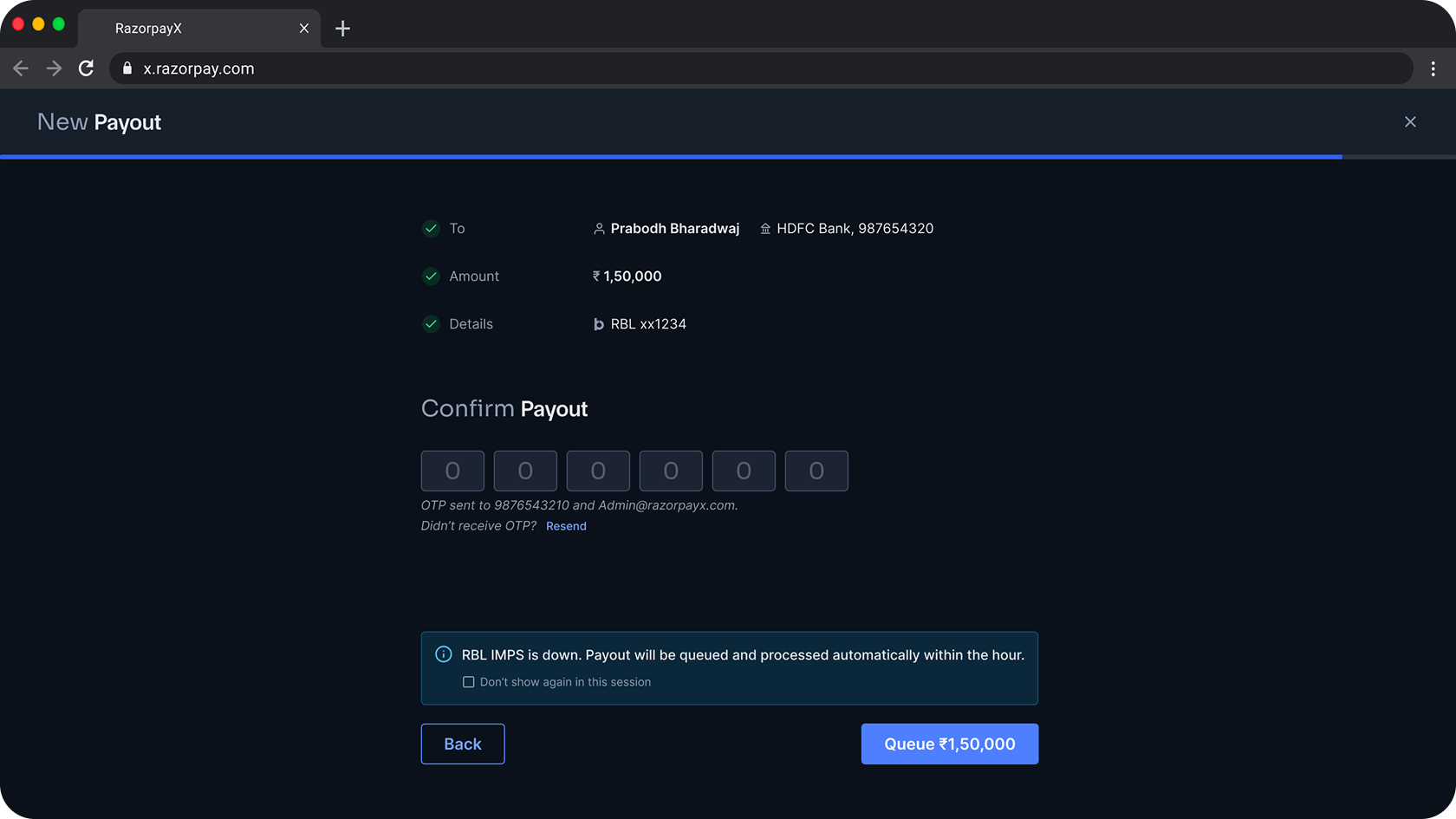
This is the final point of decision for a payout. So it’s important to confirm with the user
whether it’s a bene bank downtime or a partner bank downtime. Users always have the option
to dismiss the alert for that session.
The CTA is modified to ‘Queue ₹X’ to set expectations with the user on what’s going to
happen next.
4. Providing queued confirmation
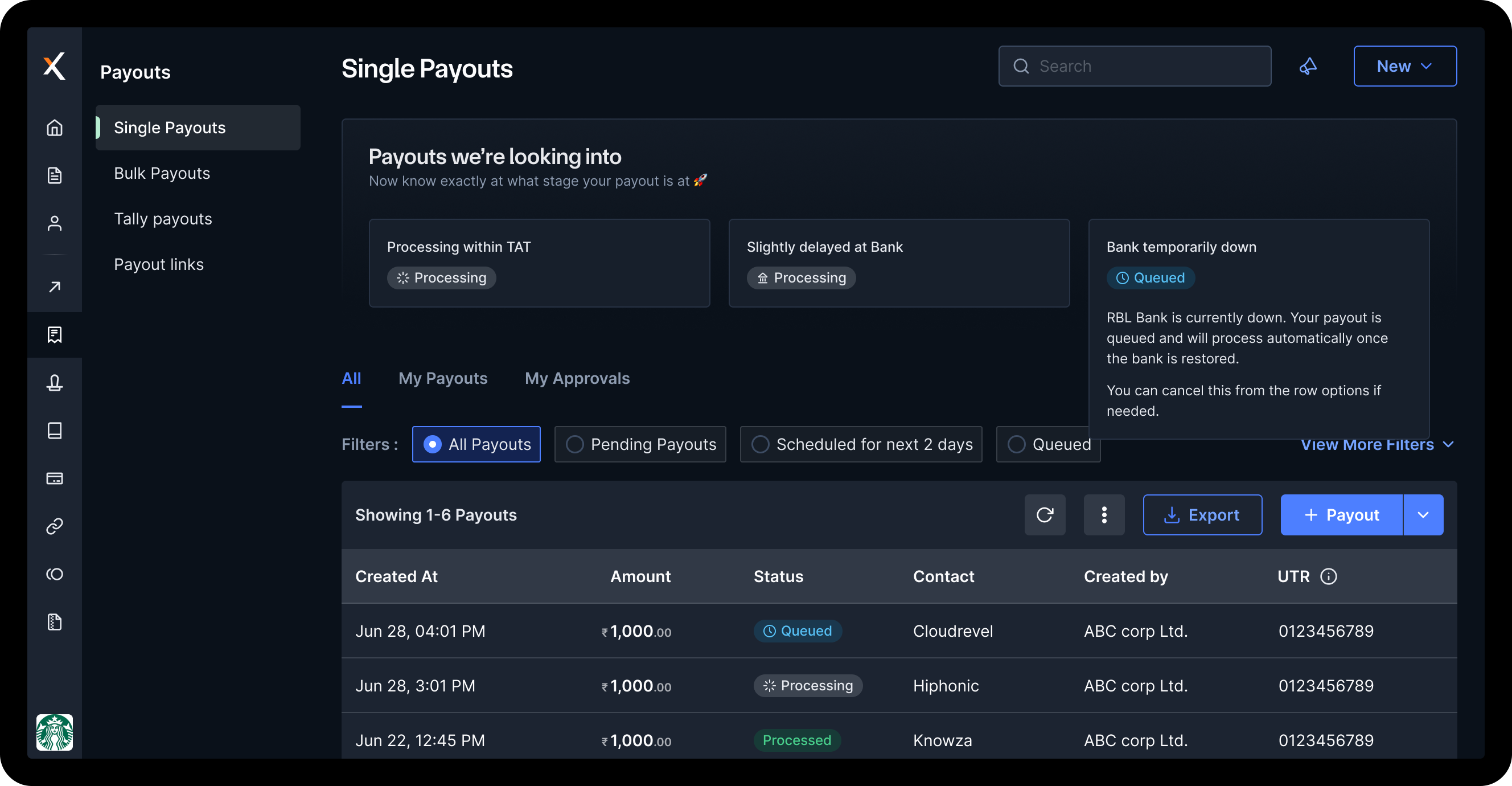
This is a very important step to bring clarity to the user on where their payments are getting stuck. This clarity helps change user’s perception that any downtime is Razorpay’s downtime.
5. Post payment user awareness
Once a payout is created and queued, users should be able to access their payouts, what the status means and how long they should wait for the payout to process. The widget on the dashboard as well as the information for the individual payout details target exactly that and keep the users updated.
What’s next?
1. Provide a success rate dashboard for banks
This dashboard should help users understand how different banks perform which enables them to choose their banking partner or raise queries/disputes when needed.
2. Payout summary dashboard
This dashboard acts as the single point of contact for users to understand what their payout success rates have been, the status distribution and alert if any in the given time frame. This also becomes an important area for us to upsell/cross-sell any features that would improve the payout performance
and more...